A previous post talked about the literary inspiration for Velikat.
Now to turn to the historical inspiration.
Difference Engines and Babbage
Is it even Steampunk if there’s not a difference engine at the heart of it?
As you may know, the first mechanical computer dates from 1822 – Babbage’s Difference Engine. It could compute mathematical tables more completely than a human ‘computer’ (a clerk employed for the purpose; in the 19th century computers were men, by the 1950s computers were mainly women – there is a great SF book about them!)
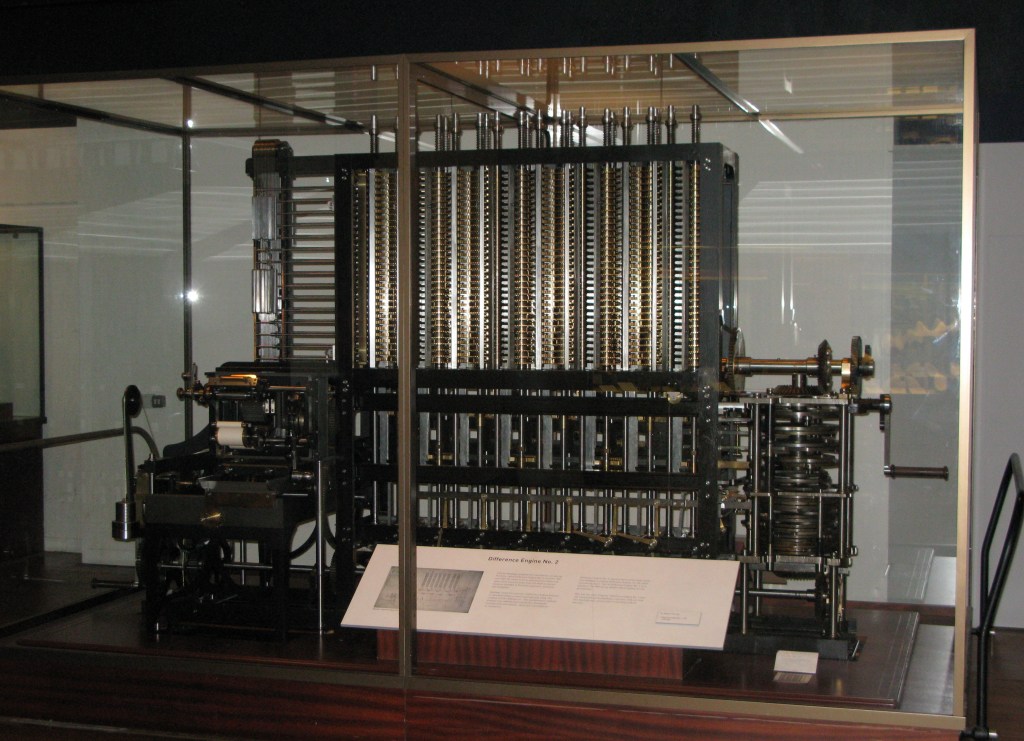
More spectacularly, by 1837 Babbage had invented a general-purpose mechanical computer, the Analytical Engine. This could be programmed; in principle it could do pretty much anything a modern computer could do. The first actual programme was written in 1843, by Babbage’s collaborator / muse Ada Lovelace (more to come about her in a separate post!).
Much steampunk (including mine) asks the question – what if Analytical Engines had unleashed an information revolution over 100 years earlier, on a society even more ill-equipped to deal with the consequences? Cyberpunk, just with steam?
Which also begs the question of why this didn’t happen in real-world history.

To which the first answer is that Babbage was an appalling project manager. He secured plenty of funding for his Difference Engine, but never completed it, after delays and cost spirals. His drawings were incomplete and idiosyncratic, his the wording of his contract with Joseph Clement the engineer tasked on actually building the Difference Engine was unhelpful, and the relationship between the two was awful.
What if Babbage and Clement had been able to come to an agreement? We know, after all, that Babbage’s Difference Engine could work; several have been built using methods available at the time.
Would the late-19th century have been filled with ever-larger Analytical Engines? Would these machines have abandoned numerical calculation for Boolean logic of AND and OR functions as mathematical algebra developed alongside them?
Not necessarily. The development of the electro-mechanical, and then electrical, computer depended on there being problems to solve which could be done more quickly and accurately than by machine than by hand.
First, gunfire. By around 1900, battleships at sea were expecting to fire their immense guns at targets 10 miles away or more, where shells might be in the air for one or two minutes before reaching their target. Calculating the correct angles to lift and turn the gun turrets, bearing in mind that both the target and the ship firing were steaming at perhaps 20 miles per hour – this was a task that needed a computer, like this one:
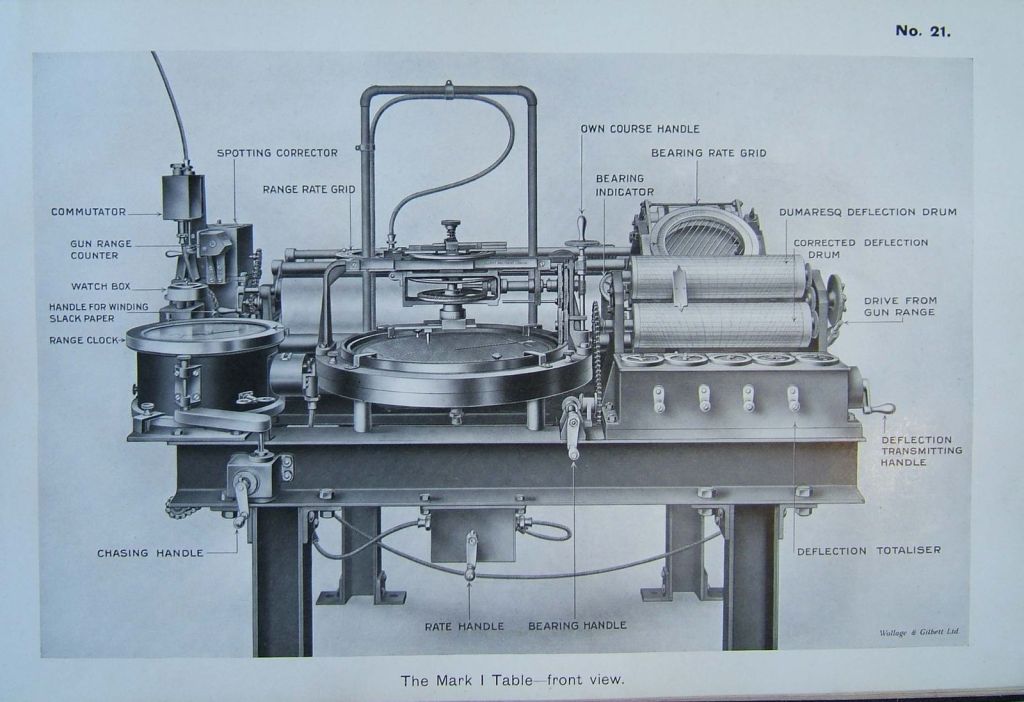
But this was 1900’s problem. Long-range shellfire needed advances in metallurgy and chemistry for long, heavy-calibre gun barrels with advanced propellants – advances driven in part by decades of strategic competition between Britain, France and other nations. In the 1840s, most naval guns were cannon of the sort familiar from the Battle of Trafalgar or the average pirate movie, best used right alongside the enemy; no use fitting an Analytical Engine to that kind of warship.
Secondly, and more famously, codebreaking. You have almost certainly heard of how the Enigma code was cracked in the 1940s. Now, codes of that complexity could have been needed earlier. World War I saw almost exactly the same use-cases as World War II with Britain enciphered radio transmissions to German submarines. Radio was first used for long-range broadcasts in the 1900s, though international telegrams were heavily used from the 1880s onwards. Could one imagine Analytical Engines being used to encode and decipher top-secret telegrams? Perhaps!
 C J Keating Writer


